



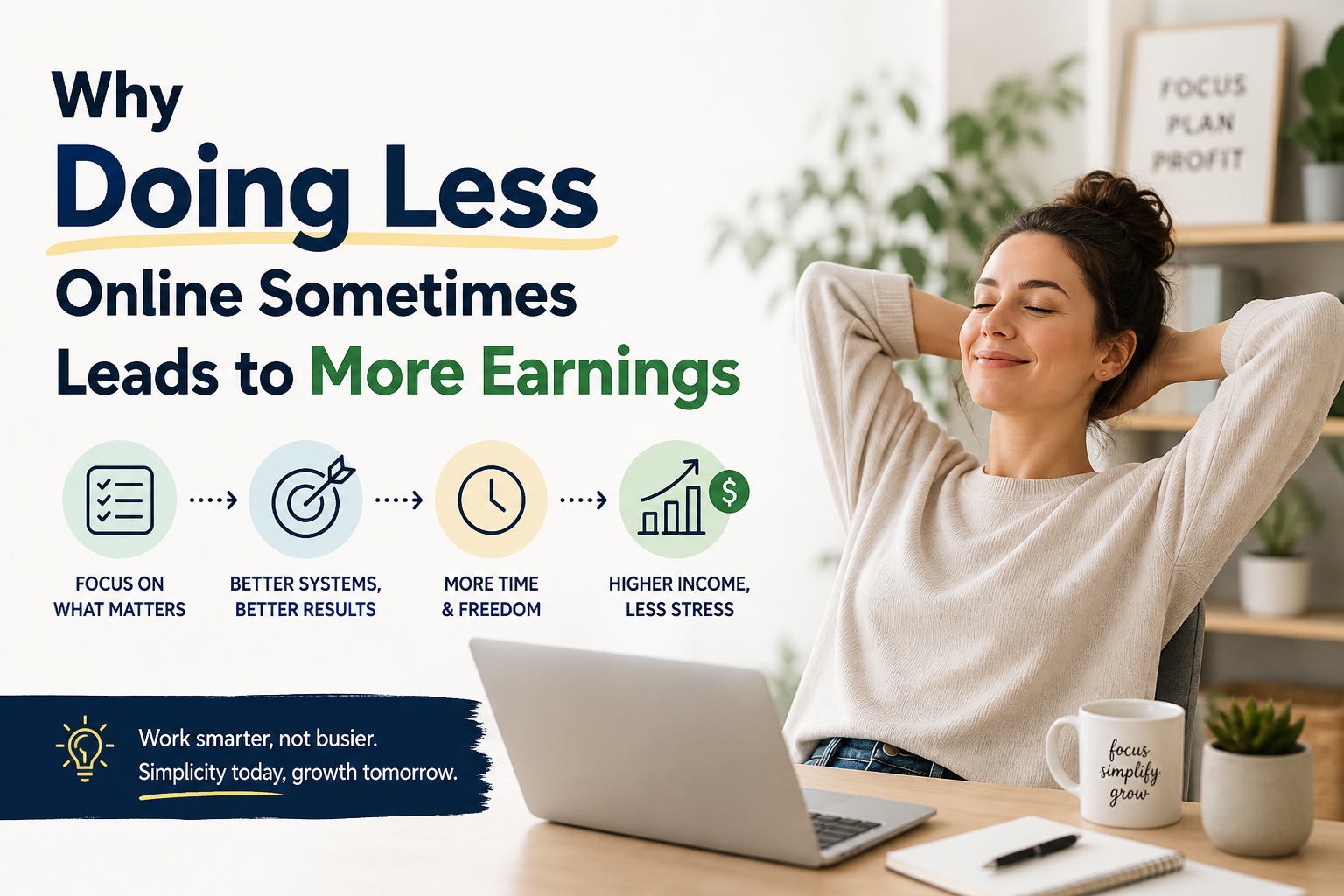
posts, more ads, more offers, more hours. But in reality, many top performers discover something surprising: doing less, but doing it smarter, often leads to higher and more stable income.
This idea isn’t about laziness. It’s about focus, strategy, and removing wasted effort.
1. The Myth of “More Work = More Money”
Most beginners think online income works like a straight line:
More activity → More traffic → More earnings
But the internet doesn’t reward effort equally. It rewards impactful actions.
For example:
- 10 random posts may bring zero results
- 1 well-optimized post can bring consistent traffic for months
- 5 low-quality offers may earn nothing
- 1 high-converting offer can outperform everything
Doing more without direction often leads to burnout—not profit.
2. Why “Doing Less” Works Better Online
1. Focus increases quality
When you reduce distractions, your work becomes sharper. Instead of managing 10 things poorly, you manage 1–2 things exceptionally well.
2. Algorithms reward consistency, not volume
Platforms like Google, YouTube, and social media prioritize:
- Engagement
- Relevance
- Consistency
Not random activity spikes.
3. Less noise = better decisions
When you’re not constantly switching strategies, you start noticing:
- What actually brings traffic
- What converts users into buyers
- What content keeps people engaged
3. The “80/20 Rule” in Online Earnings
A major principle behind doing less is the Pareto Principle:
80% of your results come from 20% of your actions.
In online work, this usually means:
- 20% of content brings 80% of traffic
- 20% of offers bring 80% of earnings
- 20% of strategies give 80% of success
Smart creators identify that “winning 20%” and double down on it—while ignoring the rest.
4. Real Examples of “Less Work, More Money” Strategy
Example 1: Blogging
Instead of publishing 20 weak articles:
- Write 3 high-quality SEO blogs
- Optimize them properly
- Update them regularly
Result: steady organic traffic over time.
Example 2: Affiliate Marketing / Rewards Sites
Instead of promoting 50 offers:
- Focus on 2–3 high-converting ones
- Test and optimize landing pages
- Build trust content around them
Result: higher conversion rate, less effort.
Example 3: Social Media Growth
Instead of posting daily low-quality content:
- Post 2–3 strong, valuable posts per week
- Focus on engagement and retention
Result: algorithm pushes your content further.
5. The Hidden Cost of “Doing Too Much”
Doing more than necessary creates problems:
- Mental fatigue
- Lack of consistency
- Confused strategy
- Poor quality output
- No time for optimization
And online income depends heavily on optimization, not just creation.
6. What “Smart Less Work” Looks Like
Doing less the right way means:
- Tracking what actually works
- Cutting low-performing tasks
- Automating repetitive work
- Focusing on one main income channel
- Improving instead of multiplying efforts
It’s not about reducing effort—it’s about removing waste.
7. The Shift in Mindset
To earn more while doing less, shift from:
❌ “How can I do more?”
✔️ “What actually brings results?”
❌ “I need to be everywhere”
✔️ “I need to be effective in the right place”
❌ “More effort means more success”
✔️ “Better decisions mean more success”
Conclusion
Online success is not about constant activity—it’s about controlled, intentional effort.
Those who learn to do less but focus better often:
- Earn more consistently
- Burn out less
- Grow faster long-term
In the digital economy, simplicity isn’t laziness—it’s strategy.